
Person
Caitha, Goddess of Tears
Mentioned character in Dark Souls II and a mentioned character in Dark Souls III
Caitha, Goddess of Tears (涙の神クァト), sometimes simply known as Goddess Caitha (女神クァト), is a mentioned character in Dark Souls II and a mentioned character in Dark Souls III.

Dark Souls II
Caitha is the goddess of tears worshipped in Drangleic and its neighboring lands, and was commonly viewed as a compassionate deity that comforted people in times of tragedy. Her tears were believed to have magical properties.
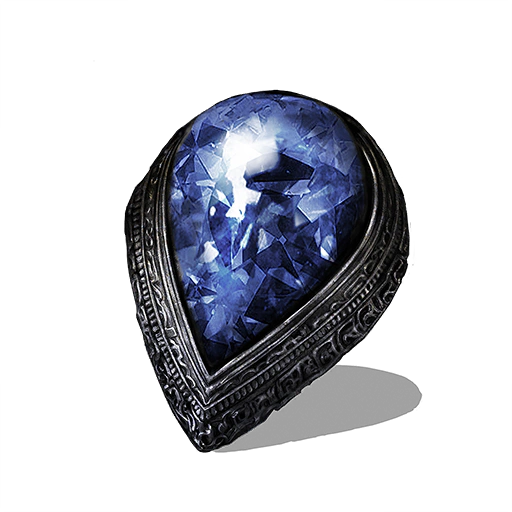
She was said to mourn the undeserving dead, shedding tears as red as blood, and those who have lost loved ones, shedding pure tears of blue, for which she earned her title. These tears of the deity were believed to be the stones set in magical rings, artifacts which shared their powers with gems that originated in Catarina and Carim.
However some believed that Caitha was in fact an evil god that guided humans towards misfortune, as her chimes enable the casting of hexes. This was a branch of dark magic rooted in both sorcery and miracles instead of the miracles typical of a god, and was therefore banned in most lands.
Her symbol varies between game versions. In Dark Souls II, it's the icon used for curse and curse build-up, while in Scholar of the First Sin it was changed into the poison and poison build-up icon that previously belonged to the God Galib, likely to emulate the shape of a teardrop.

Dark Souls III
Unlike most gods from the time of Drangleic, Caitha and her cult endured throughout the centuries into the age of Lothric, owing to the persistent worship of the goddess who soothed those in pain. It is during this time that she met the knight Morne and accepted him as her follower, who vowed to help Caitha provide comfort to those suffering. He was witness to her miraculous deeds as well as the tragedy and death that surrounded his goddess. Her tears of mourning and sorrow materialized as divine artifacts.
Things would eventually change with the involvement of the Way of White, now settled in Carim after Allfather Lloyd's claims for the title of Chief God were refuted due to being a collateral relative of Gwyn, leading to the end of his cult. This allowed Gwyndolin to seize the title as the only extant relative of Gwyn, and it was presumably by his hand that the Goddess of Tears would be recognized as an important deity of the faith. Morne, apostle to the Archbishop of Carim, spread Caitha's faith through the tales of his goddess; his devotion inspired the knights of Carim to follow in his ways and adopt his armor and weapons.
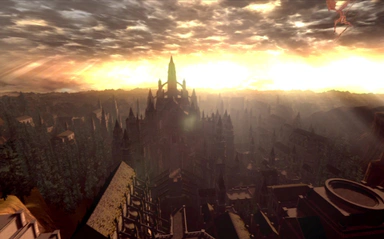
It's probably during this time that the Way of White built a cathedral to honor Caitha: the Cathedral of the Deep. The structure was lined with statues that depict a weeping maiden, evocative of the goddess, and hosted a large cemetery, tying to her domain over the dead and mourning. The cathedral grounds were used to cleanse humans from stagnant darkness in rituals that involved bloodletting, utilizing the sacred nature of the mysterious Deep to do so. Three archdeacons were appointed to manage the cathedral's operations.
Possibly due to the gruesome rituals within the Cathedral, the waters of the Deep were over time corrupted, with the dregs from its depths birthing abominations. The clerics of the Cathedral were haunted with visions of an encroaching darkness, sparking a wave of change in their faith. Led by the visionary cleric Aldrich and the three archdeacons, they abandoned their faith in Caitha, covering up most of her statues, and deemed her chimes anathema, hiding them away.
Within the Cleansing Chapel neighboring the Cathedral, Slave Knight Gael can be found on his knees praying to one of the covered statues of the weeping maiden, calling out to her as a "merciful goddess" and "mother of the forlorn, who have no place to call their own". Whether Gael refers to Caitha herself, or if he, in his madness, glimpsed the likeness of the beloved mistress of his cold home, is unknown.

Sources
Adapted from the original article, under CC BY-SA 3.0.